
What You Need to Know
- A restaurant renovation contractor who finishes on time prioritizes scope clarity, internal team control over MEP systems, and proven mall project experience, not lowest price.
- Tight deadlines require written milestones, advance mall access booking, and confirmed inspection slots before work begins. Vague timelines invite delays that push opening dates backward and erode projected revenue.
- Contractor setups differ in risk, a full-service team that owns construction, MEP, and finishing under one schedule is the most predictable choice for a 100–300 m² restaurant with a fixed opening date.
The restaurant renovation contractor Jakarta owners appoint for a mall project usually decides whether the opening date holds. That date is rarely flexible, lease terms, marketing, and staff hiring all lock onto a single day, while the renovation schedule is the one variable an owner cannot control directly.
This guide covers how to evaluate a contractor for a deadline-driven project and the traits that predict on-time delivery. It also looks at the delays that most often push handover backward, the checks worth running before you sign, and the contractor setups best suited to a tight timeline.
How to Choose a Restaurant Renovation Contractor in Jakarta
When you commit to a lease on a Jakarta mall restaurant space, the clock starts immediately. Landlords expect rent to begin by a fixed date, and every week your kitchen remains under construction is revenue lost. Choosing the right restaurant renovation contractor in Jakarta becomes a financial decision, not just a construction one.
A contractor that finishes on time separates itself through three measurable traits:
- Scope clarity, meaning projects are completed within the agreed scope rather than through hidden work discovered mid-construction that stretches the timeline
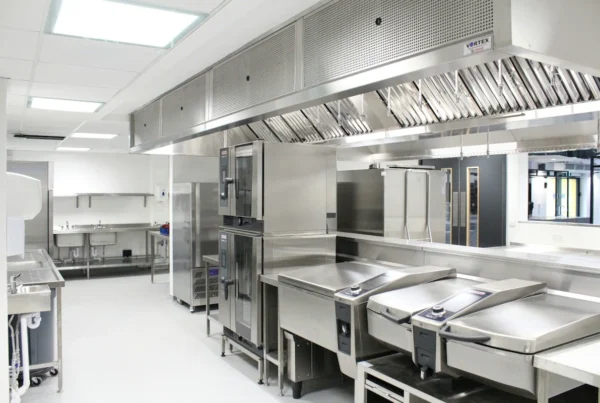
- Internal control of critical systems, with mechanical, electrical, plumbing, exhaust, and grease trap work handled by their own people rather than external partners who follow their own schedules
- Mall-specific experience, built on completed restaurant and cafe projects inside malls, where access windows are restricted and inspections follow strict protocols
A tight deadline narrows your contractor list significantly. The lowest-cost bid often comes from firms unfamiliar with commercial kitchen complexity or mall permitting requirements. These contractors bid low because they have underestimated scope or they plan to recover costs through change orders once work begins. By the time you discover the mistake, your opening date is already slipping.
Understanding Common Schedule Delays
Restaurant renovation timelines overrun for predictable reasons. Understanding these pitfalls helps you recognize which contractors have systems to prevent them:
- Late approval of architectural drawings delays equipment procurement, since kitchen items like hoods, grease traps, and refrigeration units are lead-time items that can take several weeks to arrive after order confirmation, depending on supplier and specification
- Unclear sequencing between mechanical-electrical-plumbing (MEP) work and interior finishing creates bottlenecks when trades overlap without coordination, forcing one crew to wait while another completes their portion
- Mall access windows that are not booked in advance restrict when contractors can enter common areas for exhaust ducting, electrical routing, or delivery of large equipment, forcing work to wait for the next available slot
- Missing inspection slots with health departments or building authorities stall final certification, since inspectors often schedule weeks out and rescheduling adds another delay cycle
- Design that keeps changing after work starts, because Ardeco’s benchmark of 6–8 weeks for a 100–300 square meter restaurant renovation assumes the drawings are locked before mobilization
- Incorrect sizing of utility systems discovered during inspection forces rework, such as undersized exhaust ducting or inadequate grease trap capacity that health inspectors reject
When you understand these patterns, you can ask contractors directly how they prevent each one. A contractor with real systems answers in specifics, naming who books mall access, when drawings must be frozen, and how long each major equipment item takes to arrive.
Several of these delays are decided long before anyone picks up a tool. Equipment lead times, permit lodgement, and inspection bookings all sit in the planning phase, which is why custom fit-out preparation deserves as much attention as the build itself.
Vetting a Contractor Before Signing
Before committing to a contractor, run concrete checks that reveal whether they have systems to protect your opening date. Proof carries more weight than credentials, and a list of completed mall venues with dates you can verify says more about schedule discipline than any certificate.
Two checks matter most, past mall projects with their real completion dates and the way the contractor structures accountability once work begins. Both are questions you can raise in a first meeting, and the quality of the answers is already a signal.
Read also: Building Permits for Restaurant & Cafe Renovation in Indonesia: What You Need and Who's Responsible
1. Checking Past Mall Projects and Their Actual Completion Dates
Ask for the names of three to five restaurants or cafes the contractor completed inside Jakarta malls within the past three years, along with the original agreed completion date and the actual handover date. This is not a trade secret, because these venues operate openly and the dates can be checked independently.
Opening dates are public because owners promote them on Instagram, their websites, and local media. Compare those announcements against the timelines the contractor claims, and contact a venue directly where possible. Reluctance to share the list, vague dates, or projects that slipped by two to three months are red flags.
2. Confirming Contractor Accountability and Project Oversight Structure
Accountability is structural rather than personal. Two things reveal it quickly, how much of the work the contractor's own team performs and how precisely the schedule is written down before anyone mobilizes.
Which Systems the Contractor Handles In-House
Ask explicitly which systems are handled by the contractor's own team and which go to external partners. Internal work typically includes general construction, interior finishing, and drywall. Critical MEP systems, mechanical, electrical, plumbing, exhaust installation, grease trap setup, and kitchen equipment connection, should be handled by the contractor's permanent team or closely supervised partners.
If the contractor subcontracts everything and merely coordinates, they have limited control over schedule decisions made by external trades. A contractor that employs full-time MEP technicians and kitchen installation specialists owns the schedule in a way that a pure project manager cannot. Ask, too, what support continues after opening: technicians on standby for MEP and furniture matter in the first weeks of service.
The Phase-by-Phase Timeline in Writing
A professional contractor provides a detailed timeline broken into phases, design finalization, procurement, structural prep, MEP installation, finishing work, and inspection coordination. Each phase should list the responsible party, start date, duration, and what must be completed before the next phase begins.
Vague timelines like "construction will take three months" hide assumptions that may not hold. Ask what happens when a phase slips, who absorbs the cost of overtime or weekend mall access, and how recovered time is documented in the following progress report.
Contractor Setups Compared for Tight Deadlines
Different contractor structures suit different project needs. The table below compares setups by their suitability for restaurants and cafes with strict opening dates, using Ardeco’s benchmark of 6–8 weeks for a 100–300 m² restaurant as the reference point. Other durations depend on scope and should be confirmed after a site survey.
| Contractor Setup | Project Scope | Schedule Risk | Timeline Typical |
|---|---|---|---|
| Single subcontractor handling small fit-out with simple utilities | 50–80 m² cafe with minimal MEP changes, interior finishes and fixtures only | Low. Scope is bounded and coordination overhead is minimal | Usually shorter than a full restaurant fit-out; confirm after a site survey |
| Full-service contractor managing construction, MEP, and interior finishing in one schedule | 100–300 m² restaurant with new kitchen, exhaust system, and grease trap installation | Medium. Contractor owns all trades but must coordinate across multiple teams | 6–8 weeks once the design is final (Ardeco benchmark) |
| Separate trades coordinated by the owner or external project manager | Any size. Trades hired independently and owner manages sequencing | High. Coordination breakdowns between unrelated contractors are frequent | Longest and least predictable, because no single party owns the timeline |
| Contractor partnering with architects and interior designers while design is still being refined | 100–300 m² restaurant with uncertain final layout or equipment placement | Depends on how quickly the design is locked; buildability is checked early, so fewer redesigns once work starts | Design time plus 6–8 weeks once the design is locked |
For a tight deadline, the second option, a full-service contractor handling all trades, delivers the most predictable schedule because a single entity owns accountability across every phase. The first option suits very small, simple projects with minimal MEP changes.
The third option, separate trades coordinated by the owner, is best avoided unless you have experienced project management in-house. The fourth can still work, but it demands the discipline to lock the design quickly, since every week spent refining drawings is a week the build cannot start.
Complexity also shapes the choice, as fine dining projects and fast-turnaround cafes place very different demands on a schedule.
Find Restaurant Renovation Contractor Services in Jakarta with Ardeco
When your opening date is fixed, a restaurant renovation contractor Jakarta owners can rely on controls the schedule through internal expertise, proven mall experience, and clear accountability. A contractor that shifts risk to you through vague timelines or external dependencies is gambling with your lease obligations.
Ardeco is a contractor for restaurants, cafes, and retail spaces, mostly inside malls, and has completed more than 300 projects since 2010 under the 3 Pasti Ardeco: On Budget, On Design, On Time. On timing, 99% of Ardeco’s commercial projects finish before the lease period starts. Johnny Rockets has trusted Ardeco with 7 locations over 14 years without a tender, including two projects at international airports, and Bacha Coffee at Plaza Indonesia was completed in 4 months, including R&D for carved cabinetry built from scratch.
MEP, exhaust, grease trap, and kitchen equipment installation are handled by Ardeco’s own team, while specialist works go to partners that Ardeco coordinates. Ardeco does not design in-house; it builds from your architect’s drawings or works with its partner architects and interior designers. After the restaurant opens, Ardeco technicians stay on standby for MEP and furniture.
Reach out to Ardeco to start planning your restaurant renovation with a team built for tight deadlines. Discuss your project timeline and space requirements, or see a completed restaurant to get a sense of the scope, layout decisions, and finish quality involved.
FAQ
How long does a restaurant renovation in a Jakarta mall usually take?
Based on Ardeco’s projects, a restaurant renovation of 100–300 square meters usually takes 6–8 weeks, provided the design is final before construction begins. Larger units, structural work, or imported kitchen equipment with long lead times can extend that.
Treat these ranges as planning benchmarks rather than guarantees, and ask each contractor for a phase-by-phase schedule for your specific unit.
Is it safe to hire a restaurant renovation contractor in Jakarta with no mall project history?
Hiring a contractor without mall experience carries significant timeline risk. Mall projects operate under restrictions that general contractors may not understand, limited access hours, shared utility systems, coordinated inspections with mall management, and mandatory use of mall-approved vendors for certain work. Prioritize contractors with demonstrated mall restaurant and cafe projects.
Why does a renovation contractor ask for drawings before quoting?
Professional contractors request drawings because accurate quotes depend on scope clarity. Without drawings, a contractor can only guess at MEP complexity, finish specifications, and hidden site conditions. Detailed drawings allow a contractor to price accurately and commit to a schedule with confidence.
How can you check the contractor's schedule during construction?
Establish a weekly site meeting schedule with the contractor where progress is documented with photos and compared against the agreed milestone timeline. Request written updates showing which tasks are complete, which are in progress, and which are upcoming. Any delay beyond one week should trigger a discussion about recovery options.
Is a lump-sum (borongan) or daily-rate (harian) contract better for a restaurant renovation?
Lump-sum contracts (borongan) are generally preferable for restaurant renovations because they lock the contractor into a fixed price and schedule, placing the risk of scope underestimation on the contractor. Daily-rate contracts (harian) shift that risk to you, since a longer project simply means a larger bill. Require written milestones in either contract type to enforce schedule discipline.